Kvutsat Avoda (Work Group) Theater Ensemble
קבוצת עבודה
Home for new Israeli Drama

Menu
Lady Amar
The successful show that moved thousands of viewers in the film version!
Directed by: Yigael Sachs and Noam Gil
Screenplay: Noam Gil (based on the play "Lady Amar" by him)
Producer: Yigael Sachs
Photography and editing: Ofer Harari
Art and Costume Design: Zohar Elmaliah
Original music: Shushan
Makeup: Omri Arbiv
Main recorder: Daniel Shitrit
Chief Illustrator: Avishai Azulai
Director: Eyal Obruger
Soundtrack design: Shahaf Geshel
Production: Work Group
Cast:
Orly Tobaly
Itzik Golan
Liz Rabian
Victor Sabag
"
"A fine performance by the four actors and Tubli at their head"
(Yael Shuv, Time Out)
"Made with sophistication and intelligence... the actors do a fantastic job"
(Nahum Mochich, The Stage)
"An intimate and moving little film that raises difficult questions... a beautiful and moving experience"
(Eyal Schindler, Kan Culture)
"A cinematic version that is passionate, cunning, and rough around the edges, just as it should be"
(Benjamin Tovias, Yediot Ahronoth)

By Noam Gil
Lady Amar
An elderly woman is kidnapped in the middle of the night. She identifies as Pauline Weiss - the wealthy director of a non-profit organization. She demands her captors immediately release her back to her wealthy and well-connected husband, but they claim that she is their mother, Jackie Amar, a poor widow who has lost her mind. The fight between them becomes a struggle of identities, which examines the social divisions and gaps in Israel from a new and surprising angle.
Cast:
Orly Tobaly
Yaakov Zada Daniel/ Itzik Golan
Liz Rabian
Victor Sabag
Directed by: Yigael Sachs
Set and costumes: Zohar Elmaliah
Lighting design: Amir Castro
Music: Shushan
Dramaturgical Consulting: Roy Chen
Director: Henny Yeshayahu
M.Presentation: Shaked Schneller

The play was developed with the assistance of the Starting Point Program, founded by Mifal HaPais.
"Lady Amar" is a very interesting play centered on an Israeli family of Moroccan origin, dealing with what seems to be a split personality of the mother: she believes she is an Ashkenazi socialite. Her children try in vain to convince her to take medication, but she stubbornly refuses. The dialogues between the mother and her children are funny and liberating. They accurately expose the stereotypes not only about "Mizrahi" people, but also the fantastic image that the "Mizrahi" outsider has of the "perfect" dominant group. This is a work with vision that requires an actress with virtuoso acting ability."
Eitan Blum/ Haaretz
"An impressive presentation of a play, direction, design and acting from the best of Fringe Theater." Zvi Goren, The Stage Website
"Orly Tobly as Jackie/ Poulin presents a wonderful character... Her text work is wonderful and precise" Nano Shabtai, Haaretz
"Sax and Gill, who have collaborated fruitfully in the past, have once again created a complex, charged and bloody issue that seeks to map the ethnic division in Israel" Yuki Lavie/ Cafe de Marker
"I left excited... a great joy for lovers of true theatrical art, who are more interested in human destinies than in spectacular effects." George Militiano/ Leviathan
Gallery
 |  |  |  |
|---|---|---|---|
 |  |  |  |
 |  |  |  |
 |  |  |  |
 |  |  |  |
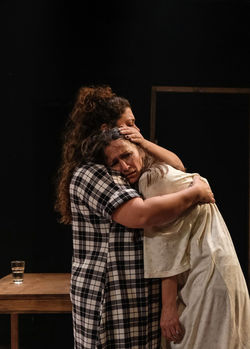
Photo: Uri Rubinstein and Dan Ben Ari


To the play's page on the Israeli Dramatists Website

19.4.19 Yuki Lavie. Cafe The Marker
Israel, Lebanon, Jordan, and Poland suddenly enter the room. No, this is not the beginning of a joke, nor are these diplomatic talks by a senior political representative. It is the feverish mind of playwright Noam Gil who, in conjunction with the "Kvutzat Avoda" ensemble, created the social thriller "Lady Amar" presented at the Tmuna Theater. Israel, Lebanon, and Jordan are a brother and sister pair who, in the dead of night, kidnap an elderly woman in the middle of the street, and place her in a dark hideout, which a few minutes later turns out to be her home. The three kidnappers tell the astonished lady - who insists that her name is Pauline Weiss, that she is married to a successful industrialist and that they are a wealthy couple with connections in high society - that she is their mother. The progressive amnesia she has suffered from has forced her to hallucinate and fall into false visions, to invent Arabian Nights stories about herself and the biography she supposedly belongs to. "Jacqueline Amar" they scold the meticulous woman, who has nothing in her accent And her intonation does not hint at the ethnic origin that her "children" seek to instill in her, much to her displeasure.
For days she will spend in the company of the three dubious people, slowly revealing the story of each and every one of them, unwillingly being sucked into the "story of her life" as they describe it to her (the gap between her and the character she walks in the world as, with a sense of lordship and satiety, is grotesque in itself), but she will insist that it is all a conspiracy. Pauline (in the negative) Weiss is not prepared under any circumstances to step into Jacqueline Amar's shoes (in the above), and will try her best to escape the place.
The play's director, Yigal Sachs, could easily have fallen into the pit of a cheap comedy of errors, the populist sitcom that such an absurd constellation gives him. Instead, he took Gil's play and built it into a patchwork of a human plot, whose central axis, while revolving around sectarian tension and the inexhaustible conflict between Ashkenazim and Mizrahi, is one that has a hint of compassion and beauty woven into it. The three children are not monsters who just molested an elderly woman who happened to be in their path. In their opinion, they love their mother, whose mind has apparently gone mad and the stories of the fabrics she weaves are becoming more and more insistent to the point of being unable to actually care for her well-being. The kidnapping for friends is for her own good, to return her to the bosom of her loving family, and through visual stimuli and exposure to the depths of the elusive consciousness they hope to succeed in their mission. Thus we will learn about the experiences of Israel, the eldest son, professionally played by Yaakov Zada Daniel, and the breakdown he is in. We will get to know in depth the many deceptive faces of Levanon (Victor Sabag) and his uncompromising rigidity. And we will mourn with the daughter, Yarden, who is played by Liz Rabian in a performance that is full of compassion. Tenderness and delicacy. The climax of the play, in my opinion, is in the interaction between the two. The daughter understands that the mother will not cooperate and in a desperate act she begs her to hug her. The body language of both of them summarizes in a nutshell all the clichés about ethnic differences, while one of them embraces the other with full emotion, while the latter demonstrates formal coolness even during this gracious physical gesture. The highlight is Orly Tubli, the kidnapped mother. She is spectacular in her vocal diversity, in her dramatic and eloquent power on the one hand, and in her humorous winks on the other. The imitation of a Moroccan woman she suddenly adopts shakes the hangar in the Tmuna hall with a roar that has not been heard in a long time. On the surface, she is the passive one of the group, dragged into this horrific saga, but in fact she is the one who steers the ship with her determination, cunning, and the viewers' curiosity related to the mystery of her identity.
Sachs and Gil, who have collaborated fruitfully in the past ("The Settler" and "Toys"), have once again created a complex, charged and bloody issue that seeks to map the ethnic division in Israel in 2019. "You are committing cultural kidnapping on me," Poland shouts at her kidnappers/children, and how ironic that the premiere of "Lady Amar" took place just days after the last Knesset elections, when the very unequivocal results they produced correspond with her words.


Benjamin Tobias - Yedioth Ahronoth
