
Jewish Playwriting – Questions of Identity and Culture
Updated: 6 days ago
Seven playwrights speak about identity and creation: What is “Jewish” in their plays? What are their sources of inspiration, and how does the creator’s identity shape the work? Joshua Sobol, Hanna Azoulay-Hasfari, Hadar Galron, Noam Gil, Hadas Calderon, Ori Egoz and Amit Zarka in a conversation about language, memory, longing, trauma, Jewish conflicts, culture, inspiration and Jewish creativity.
How would you define “Jewish playwriting”? What actually makes a play “Jewish”? The subject? The language? The writer’s identity? The characters? The audience? The sources of inspiration? Or perhaps something deeper in the playwright’s worldview?
Hanna Azoulay-Hasfari: It’s like asking me what “women’s playwriting” or “Mizrahi playwriting” is. There are no specific elements that automatically put you into that category; there is a completely subjective general impression, dependent on the identity/culture of the spectator. Is it the Jewish character? Is “The Merchant of Venice” a Jewish play? A universal play about racism? Or maybe it is about antisemitism, which is immanent in the world and occasionally erupts following different unfortunate events? Is it the language? Hebrew? Ladino? Yiddish? Moroccan Judeo-Arabic?

I recently worked on a play by Ala Dakka, a Palestinian actor/playwright born and raised in Neighborhood C in Be’er Sheva, who artfully writes and plays in Hebrew with a talent reminiscent of Hanoch Levin. Maybe it’s enough that the playwright is of Jewish origin? I know Jewish playwrights and screenwriters who tell stories without knowing anything about Judaism. A Jewish play can be a play with a Jewish worldview, but from my experience, sometimes you “speak Judaism” only to discover that the same things are said, for example, also in Buddhism. In short, I don’t think you can determine this with certainty, but you can definitely be impressed.
Amit Zarka: For me, these are works that conduct a dialogue with Judaism as an inspiring intellectual and spiritual space. The dialogue with Halakha (the evolving system of Jewish law governing daily life and religious practice), literature, liturgical poetry and the diverse realms of Jewish thought causes the work to become a layered creation, full of references and, at its best, also subversive. It is a magnetic ground, from the Bible to Kishuf (Jewish magic), from the Talmud to the morning blessings, Rabbi Kook, Hasidism – an immense wealth of ideas.
Noam Gil: Let’s start with the fact that this is an annoying question – “What is a ‘Jewish text’?” – that no one can answer objectively or come to one agreement on. It’s also a question many use in order to distinguish between creators considered “truly Jewish” (say, S.Y. Agnon, the good Jew with the Kippah) and those who are “not really Jewish” (say, Bob Dylan). The best answer I can give is that a Jewish text deals with the Jewish identity of the characters in the play, whether explicitly or implicitly. A Jewish text is one that inquires, in one way or another, what it means to be Jewish in the period in which the text was written, what that entails and how it manifests itself. These are very open questions, but it always comes back to the question of identity.
Hadar Galron: Jewish playwriting is not a genre with rules, but a consciousness that understands its identity as a living discourse, not a given permanence. This is theater in which nothing ever completely closes, because meaning itself is under endless discussion. In this sense, many of my works begin precisely from that place: not “what’s the story”, but what interpretations already exist around it. When I touch Talmudic figures like Beruriah or Yalta in “400 Barrels of Wine” (Ariel Theater, Philadelphia), or Yael and Tamar in “Poskot” (a new production at the Library Theater), it is not an attempt “to tell their story”, but to restore to them the possibility of arguing with the way their stories have been told. That may be the main difference – it is not only Jewish content, but a way of living within texts that are already speaking about you. Texts that existed before me and will go on quarreling long after me.
Joshua Sobol: Jewish playwriting is playwriting that deals with the drama of Jewish existence, from the day Abram was told, “Go for yourself from your land, from your birthplace and from your father’s house, to the land that I will show you,” until the day that same inner voice told the pioneers of the First, Second and Third Aliyah to leave their lands and birthplaces for the land in which they would repair the existence of the people whom Haman defined with the words: “There is one people scattered and dispersed among the peoples... their laws are different from those of all other peoples, and they do not obey the king’s laws – and it is not in the king’s interest to tolerate them.” Jewish playwriting is playwriting that deals with this existential, fateful rift between a person and his place, a rift that becomes a rift between generations and families, a rift that in our generation has been nicknamed “relocation”, which is in fact a “distancing” between sons and daughters and their parents, a rift that takes on different forms throughout Jewish history.
Ori Egoz: There are several approaches to what Jewish playwriting is. One approach linked Jewish playwriting to plays written in Hebrew, Yiddish, Ladino and the like; for example, Yiddish theatre was perceived as an explicitly Jewish space. Today, however, scholars see this as only a partial criterion. Neil Simon wrote in English and is still associated with Jewish playwriting because of his focus on family. That is essentially the second approach, in which subject matter defines what Jewish playwriting is: themes revolving around Jewish experience such as exile and memory, tradition versus modernity, antisemitism, migration or belonging. The third approach deals with an intellectual-cultural definition, as Prof. Yair Lipshitz suggests: not what the play is about, but how it thinks – its modes of expression, multiplicity of voices or conversation with past texts. In my view, Jewish playwriting is a combination of all three. It draws from the Talmudic conception of dispute and does not fear it; it asks questions about central issues in Jewish identity and events that are part of the Jewish and Israeli experience; it presents the Jewish and Israeli world, and it does not have to be in Hebrew, Yiddish or Ladino, though language adds another layer of associations that only a native speaker will fully recognize.
Would you describe the theater you create as “Jewish theater”? What is the relationship between your personal identity and the identity of your works?
Hadar Galron: Yes and no – which already sounds to me like a good beginning for a conversation. There is a lot of conversation with Judaism in my theater: texts, interpretation, sources and the status of women within all this. It comes from the place where I grew up, but if I call it only “Jewish theater”, it's a bit reductive. Because these same works also contain very human and universal relationships: power, family, body, humor, fears – things that do not belong only to Judaism. In “Mikveh”, the conversation about the body, purity and control is at once highly local and deeply, universally, human. In “The Secrets”, gender power relations become something both political and very intimate. Perhaps the most accurate way to put it is that these works are not written in order to be “universal”, but they do manage to function that way because they come from a very specific place.

The Secrets by Hadar Galron, Beit Lessin Theatre, photo: Kfir Bolotin
Noam Gil: I would call the theater I want to make “Noam-Gil theater” (named after myself, of course). My Jewish identity is part of me, but not all of me, so I I I assume what I create is also Jewish, but not only that.
Joshua Sobol: In my play “Sylvester 72”, a confrontation unfolds between a father, a Second Aliyah man, and his eldest son who has emigrated from Israel. In “Night of the 20th”, I was concerned with the drama of a group of pioneers from the Third Aliyah, who left their lands, birthplaces and fathers’ houses for the Land of Israel, where they sought to build a future in the spirit of the vision of Ernest Renan, the French Christian thinker of the nineteenth century, who anticipated the return of the people of Israel to their land as an event that would repair European civilization.

In my play “Soul of a Jew”, I dealt with the rift tearing the soul of a young Jew between his German-European identity and the Zionist call urging him to leave his land and birthplace, and his lack of faith in the possibility of self-repair. In “The Jerusalem Syndrome”, I tried to dramatize the conflict between the religious zealotry that led to the destruction of the Second Temple and the threat that this suicidal current poses to the future existence of the State of Israel. The storm that broke out following the staging of the play, which brought an end to the theater I had helped create, forced me to leave the country for four years, so that my partnership in creating Jewish theater turned me into a kind of wandering Jew between the theater capitals of the world. In my private life I experienced the wandering of the “Wandering Jew” whose homeland became exile and whose exile became a temporary home, because he uttered a vision of future destruction, if and when this messianic-destructive Jewish force takes control of the people of Israel living in their land.
Ori Egoz: My Israeli and Jewish identities are very significant to me, and they naturally influence the subjects that concern me, whether rooted in the past or deeply anchored in the Israeli experience and our present. In the play “From Crystal to Smoke” which I wrote and adapted together with the philosopher Jacques Attali, a meeting of senior Nazis is documented, held a few days after Kristallnacht. There, the question of Jewish identity arises in the discussion of how to further reduce Jewish living space in every aspect. For me as a writer, it was shattering to enter their mindset and look through it at what “Jew” meant in their eyes. At the same time, as an Israeli and a Jew, I explored through them the roots of antisemitism.
My new play, due to open at Beit Lessin, “In the Name of the Children”, is centered on a real event that took place in the Łódź Ghetto and confronts the question of the Judenrat’s responsibility for the fate of the ghetto. It is impossible to read it today without the echo of October 7th. In this sense, because it asks about responsibility – a question already present in the stories of Abraham, Moses and the Sages – it is very Jewish. All these examples are drawn from historical contexts and real events. But is that a necessary condition for definition? I don’t think so. In the comedy “My Zakopane”, staged at Habima Theater, I returned to the Jewish world in Europe on the eve of the First World War, but it was entirely imaginary. There was a playwright and author, Sholem Aleichem, who inspired me, and a longing for that world I never knew, in which the characters operate within a framework of faith, but also under the influence of the Enlightenment, and there is a struggle between forces of modernity and tradition
Hanna Azoulay-Hasfari: For forty years I have been trying to define my identity. In the end, I understood that it is completely diffusive, and when I try to preserve parts of it, the world has already changed, and if I don’t download a system update overnight, I find I can’t function in the world. I can certainly say that when my channels are open, my writing improves and I can “speak” Jewish and Israeli and Arabic and English and French, inside a world narrow as an ant's that becomes as wide as the universe. But this is a miracle that happens once in a while, and whenever it does, I feel a moment of grace has descended upon me and I am grateful for it.
Amit Zarka: Roland Barthes writes in “The Death of the Author”: “A text is a tissue of quotations drawn from the innumerable centers of culture,” and Judaism offers equally rich rooms. Judaism shapes my identity; it is the soil on which I was grown and lies at the heart of the way I perceive myself and the world. It is the home I left and the home to which I always return. It is embedded in the Hebrew language and reflected in its layers and depth.

Hadas Calderon: My grandfather, the poet Abraham Sutzkever, believed when he was in the ghetto that as long as he wrote, he would live. He saw the artist’s role as a mission – to bring that “healing beauty” that gives the strength to live even out of destruction. In his writing, for example in the poem “On the Day of a Funeral and a Concert at Dusk, to Be Here and There – So It Was Decreed from Heaven”, he did not deal only with death, but with the ability of poetry, music and culture to save the human spirit. And in reality, poetry truly saved his life: the collection of poems he wrote daily in the ghetto was smuggled through Russian partisans to Moscow, where Stalin decided to send a plane to rescue the poet. So not only in faith, but in practice, his writing saved his life. This is also my own perception as an artist.

In your view, what texts make up the “canon” of Jewish creativity in general and Jewish playwriting in particular, and how are you influenced by this canon in your work?
Amit Zarka: Rabbi Kook is reflected in my inner world, in storms of the soul and yearning; the representations of Lilith and Eshet Chayil ("Woman of Valor") serve me in looking at femininity and in my eternal rebellion against this dichotomy of representations; Hasidism speaks to the heart; Halakha is in dialogue with law and boundaries; the wisdom of Pirkei Avot; the inspiration of Sefer Yetzira ("The Book of Creation"); the dialogue with the Ten Sefirot brought to life my latest book; the Bible from so many angles – this whole list, and I have not yet touched its edge.
Hanna Azoulay-Hasfari: Once, everyone studied certain chapters of the Bible; today I know that this is no longer the case, all the more so with foundational texts in literature and poetry. Since I come from a traditional home, the Bible flowed in my veins, even if I returned to it only occasionally; but Israeli and world literature and poetry are also part of my memory. When I write, my thoughts wander to those regions of the brain where specific texts reside and bring them to me, sometimes intuitively and sometimes deliberately. In my play “Dina”, much of which is based on the biblical story of Dinah, I realized that Dinah is essentially an at-risk girl who was raped, and I based the entire text on our national memory as Israelis who studied Bible in high school

I know that cultural scholars have established criteria for defining a text as “canonical”, but sometimes those criteria do not stand the test of time. After the death of Yehonatan Geffen, many people, myself included, posted tributes and spoke of the canonization of his texts. Then an opposing group rose up, mainly among those of Mizrahi and Russian descent, who said they had never heard of him in their childhood and had never read his texts, not even The Sixteenth Lamb. I think the polarization in Israeli society also stems from the fact that we have different education systems in this country and no shared identity-forming texts. When one group has one set of canonical texts and another group has a different set, it is easy for populist leaders to incite conflict and pit one group against the other.
Noam Gil: In my eyes, Hanoch Levin is the ultimate Jewish playwright who lived in Israel. His work is very Israeli, but also winks at a more universal Jewish identity. In general, Jewish creators in the twentieth century managed to describe the Jewish condition as a metaphor for something more universal (Kafka, for example), and Hanoch Levin definitely belongs to this tradition. Levin stands above us all as a source of inspiration and pride (Jewish and Israeli). There’s no one like Hanoch.
Which Jewish creators in Israel and around the world influence you as an artist?
Hadar Galron: I’m not sure I work from a neat “list of influences”, but there are creators I return to again and again. Isaac Bashevis Singer, for instance, because of his ability to hold, simultaneously, a very concrete world of Eastern European Jewish life alongside something almost mythic and inexplicable – as if reality is always doubled or tripled. I identify with that place.
Chaim Potok accompanied me for years without my realizing it, mainly because of the tension he maintains between a world of tradition and a world of personal choice/freedom – not as a sharp conflict, but as something bubbling inside the characters, sometimes quietly.

Hélène Cixous – not from the “Jewish” world in the narrow sense, but from the world of writing that understands language itself as a site of power, of the body, and of an identity fighting for its existence within text. She is brave and inspiring. When I read her essays early in my studies, she gave me a lot of courage.
Hanna Azoulay-Hasfari: In Israel I was, of course, influenced by my partner Shmuel Hasfari, Hanoch Levin and others. Internationally, by Tony Kushner, Pinter and others who deal with human rights and liberalism
Joshua Sobol: The playwright who influenced me and my work more than anyone else was the grandson of a Portuguese Jewish converso who emigrated to England and was registered in the municipality of Stratford under the name Shapira or Shapiro. His son anglicized the name from Shapiro to Shakespeare, according to the claim of the French theatre scholar Ghislain Muller in his book Was Shakespeare a Jew?. Muller argues that William Shakespeare knew Hebrew and had some knowledge of the Talmud, and in my eyes The Merchant of Venice is a Jewish play in spirit.
I was also influenced by Mendele Mocher Sforim’s critical view of idleness and schlumpiness in everyday life as a Jewish social illness, and by Brenner’s scorching critique of rabbinic literature and the Jewish culture influenced by it, which became an interpretation of an interpretation of commentators on commentators, detached from life
What do you think about the concept of “cultural appropriation” in the context of Jewish theatre?

Noam Gil: Jewish identity is perhaps the last within “minority culture” that still allows cultural appropriation, primarily because the “Jewish condition”, especially after the Holocaust, appealed to many non-Jews. During those years, Jews were perceived as heralds of a universal condition of alienation and destruction. This is one of the reasons why, for example, Jewish characters are often played by non-Jewish actors (unlike films or plays about Black people, Hispanics, gays and lesbians and other minority groups, where nowadays you cannot portray a character not biographically related to you). I like the fact that the discourse about Jews is still relatively honest and unsentimental, probably thanks to the new antisemitism
In your view, what is the difference and connection between “Israeliness” and “Jewishness”? Is there a tension between these two identities? How does it manifest in your writing?
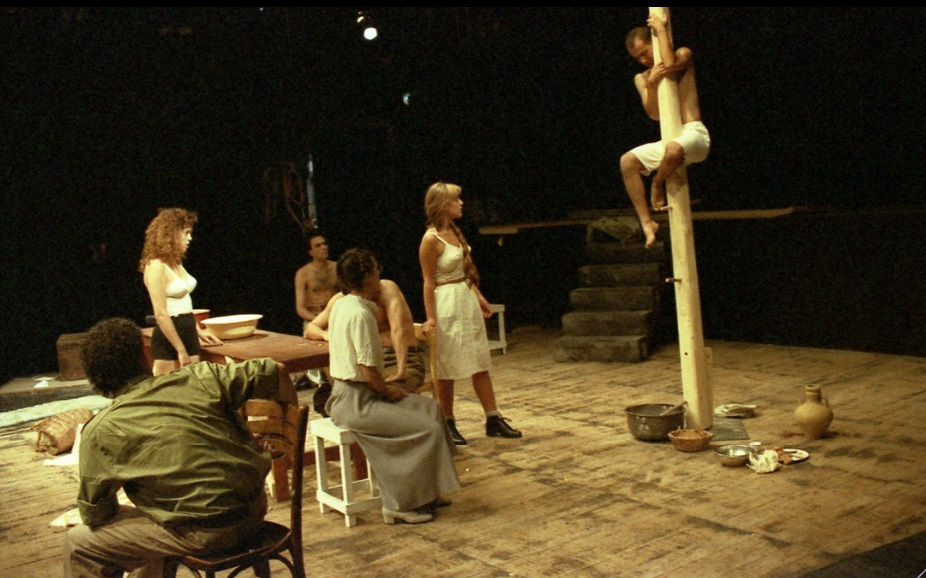
Joshua Sobol: Israeliness, in my eyes, is the extraction of the people of Israel from their Jewish-exilic existence as dispersed communities and families whose lives depend on the grace of sovereign peoples. Israeliness is the bringing of the Jewish diaspora into political existence as a sovereign Hebrew nation responsible for its own survival and seeking to be an equal partner in the family of nations. These two modes of the people of Israel’s status among the nations naturally create great tension between Jewishness and Israeliness. Jewishness was characterized by a humiliated-yet-condescending attitude towards the “locals”. A Jew passing by a church would stick his hand in the pocket of his kapote and make a hidden obscene gesture – “a fig in the pocket” – towards the church. An Israeli would not dream of performing such a degrading act that would debase him in his own eyes While Jewishness disavows from the outset any responsibility for the deeds and behavior of Jews towards non-Jews, Israeliness, which aspires to equality among the nations, is sensitive to the behavior of Israelis towards members of other peoples. For example, the authentic Israeli spirit feels revulsion, disgust and anger at the arrogant, degrading and disgraceful behavior of Minister Ben Gvir towards detainees from the flotilla to Gaza. In “Night of the 20th”, the members of the kibbutz struggle against the dust of the exilic Jewish mentality and identity clinging to them and make an effort to shake it off and adopt a new identity that will eventually become their Israeli identity and, with even greater force, that of their sons and daughters. Naphtali, the clown of the group, presents this struggle between the two opposing identities with sarcastic humor.
Hanna Azoulay-Hasfari: In my humble opinion, Jewishness is more connected to origins and global events, and Israeliness begins with the establishment of the Zionist movement in Basel and continues to this day. Usually the two are intertwined, and there is indeed a great tension between them. Roughly speaking, to me Israeliness lays claim to power and might, while Jewishness lays claim to spirituality and humanism, and the two often clash, and the big bang is happening in our own days. Something between them will prevail, and I fear Israeliness will lose because it has not known how to contain the spirituality and humanism inherent in Judaism. Spirit always has greater power because it is not a perishable material. Spirit can sometimes break, but brute force is finite.
Ori Egoz: For some people, Jewish identity is linked to a religious and faith-based world, and Israeli identity is separate and identified with this place – the sovereign State of Israel – and what it brings and symbolizes. For me, these identities are connected, even if they are not identical. In my play “Boiling Point”, which is now starting rehearsals at Dimona Theatre, I wrote about a psychologist accompanying a teenager who suffers from outbursts of rage and is later interrogated after he becomes involved in a stabbing. The question is whether she could have foreseen that this would happen. On the face of it, this is a very Israeli play, which I wrote before the murder of Yamano Zalka but in the wake of the murder of Yoel Langhel, god rest their souls. But for me, compassion is a central element of Jewish identity – compassion and a place for the stranger, the widow and the orphan, and in general, creating space for those who appear to be on the margins. So a play whose center is a teenager trying to cope with the roots of his violence, even if they are entirely personal, in fact deals with compassion and repair. Tikkun Ha-Midot (refining one’s character) is a very Jewish concept, drawing on the inner self-examination demanded of everyone. Even within a thoroughly “Israeli” play, the perspective is apparently shaped by worlds that have been absorbed into us – Jewish worlds.
Themes like the Holocaust, exile and antisemitism are part of the Jewish narrative, as are longing and nostalgia for the past. How do you deal in your work with longing, trauma and collective memory?

Ori Egoz: I try to avoid turning trauma into an abstract idea. Ultimately, memory lives through a specific person: through a movement, a silence, a small object, a sentence that remains unspoken. Jewish memory is not only a memory of catastrophes, but also of hope. We are a people commanded to remember – “and you shall tell your child” – but also commanded to go on living. I think I am mainly interested in the moment when history meets an individual: how a major event changes a family, a child, a friendship or a moral choice
Hadar Galron: I try not to turn memory into something frozen or monumental. The moment it becomes “too big”, it stops being theatre – it stops breathing. In “Whistle”, for example, there is a central gap between the creators’ point of view and that of the character. As a creator, of course I wanted to speak about the second generation after the Holocaust, about how trauma is transmitted in the blood, how it shapes identity, But the character, Tami, does not cooperate with this trajectory. She does not want “to understand her story” or to interpret it. On the contrary – she tries to repress, to escape, and to create a life which is no longer controlled by the stories that shaped her childhood. The conflict is between the desire to tell and the desire to run away from the story. In “Musrara”, memory is no longer personal or familial but social and Israeli: a neighborhood, protest, disparities and a sense among young people that reality has assigned them certain roles even before they enter it. There too, it is not “a story about the past”, but something that lives inside the present itself. In both cases, what interested me was the tension between what insists on being spoken and what refuses to be spoken, sometimes within the very same character. And humor, when it appears, is not there to soften things, but to allow them to remain alive and not turn into stone.
Noam Gil: The plays I write often focus on trauma as an event that forces the characters to create some fantasy into which they escape for themselves . Reality in Israel is harsh, and therefore many of us have no choice but to escape into an alternative fantasy that has little connection to the reality in which we live. That, in my view, is our way of coping with trauma. One of the major features of our Jewish-Israeli identity is destruction – and the fear of yet another destruction to come. These days only intensify our shared fears. We have no choice but to flee to something more comforting. In short, yes, this is part of the Jewish narrative.
Hadas Kalderon: I believe theater should not only recreate trauma, but also give the audience strength, compassion and a sense of life. Precisely out of pain, it should seek the humanity and beauty that make it possible to go on living. In “The Paper Brigade”, I was interested in how people risked their lives to rescue books and poems from the ghetto – in other words, how culture becomes an act of survival. In “The Witness”, I was not interested solely in recounting horror, but in how even at the darkest moments, creativity can bring points of light.

Joshua Sobol: I deal with historical episodes in my work only if I am able to access primary sources that can tear off the curtain of narratives fixed in collective memory, which reveal one measure and conceal two. I wrote the play “Man of the Century”, in which I sought to trace Herzl’s transformation from someone who believed in the mass conversion of the Jewish people to someone who advocated the establishment of a Jewish state as the solution to the “Jewish problem”, only after an extensive dossier about the Dreyfus Affair was discovered thirty years ago in the archives of the French Ministry of Foreign Affairs – material that had been kept as a closely guarded secret for a hundred years since the trial. This material shocked me, just as it apparently shocked Herzl, who, in his role as the Paris correspondent of a Viennese newspaper, followed the trial and its aftermath.
Similarly, my play “Ghetto” is not a metaphysical drama about the Holocaust, but a play focused on the founding of a theatre and its activity in the Vilna Ghetto during its two years of existence until the day of the ghetto’s liquidation. The play "Soul of a Jew” does not deal with the phenomenon of antisemitism accompanying humankind from the time of the Hellenistic writer Apion to Wagner or Hitler. In “Soul of a Jew”, I chose to focus on the last night in the life of the Austrian Jewish thinker Otto Weininger and on the mortal wounds inflicted on his soul by internalized Jew-hatred, to the point where he no longer believed in Zionism’s ability to overcome the curse of fatal acceptance of the exilic condition. He saw no alternative but to shoot his Jewish heart.
As an Israeli artist, what is your connection to Jewish theatre outside Israel, and in your view, are Jewish creators outside Israel familiar at all with Israeli playwriting and influenced by it?
Hadas Kalderon: My personal connection is very deep because of my work around the legacy of Abraham Sutzkever and as the artistic director of Yiddishpiel Theatre. Around the world I encounter enormous interest in Jewish culture and Israeli stories, especially those that manage to be very local and at the same time human and universal. There is something in the Jewish story of memory, survival and the search for home that speaks to audiences everywhere.
Jewish and Israeli playwriting sometimes reflects Jewish conflicts between religious and secular, Sephardi and Ashkenazi, liberal and conservative, etc. What is your attitude towards these intra-Jewish tensions and how do they affect the stories you choose to tell?
Amit Zarka: In my eyes, engaging with these conflicts is essential and immensely important – not in order simply to represent the conflict or perpetuate struggles taking place here, but to ask questions about the cultural fabric, about our relationship with ideas and ideologies, to give voice to diverse languages and room for different truths that coexist in the shared space.
Ori Egoz: Jewish culture is not afraid of dispute. The Talmud is almost built on disagreement. There was also a period in the Second Temple era when the spiritual leadership of the people of Israel consisted of a pair of sages who served together – one as Nasi (president) and the other as head of the court – such as Hillel and Shammai. The problem begins when disagreement turns into a struggle in which one side ceases to see the humanity of the other side. A collection of short stories I wrote, which have appeared in various contexts, is called “Rainbow of Brothers”, because I felt it asks questions about the range of experiences across the Israeli spectrum; sometimes, in the same situation, each side experiences reality completely differently. I am now working on a play based on one of those stories, and I find that what strongly influences me is the desire to make someone from the “other side” in the audience empathize with the side that at first glance seems distant from them. I think what creates a “rainbow” is the understanding that the other side is not a fool who understands nothing, and that you are not the only one who holds the pure truth.
Hadas Kalderon: These tensions appear in almost every one of my works, especially in creations for children and youth. Precisely through children’s eyes we can see how early in our lives questions of belonging, identity, status and social acceptance enter. In “Mai’s Dragonflies”, I was interested in how children experience social gaps, the desire to belong, the fear of being different and the need to hide pain. The same is true in “Shkhunat Chayim” (Chayim Neighborhood) and other projects I am developing. I believe playwriting for children and youth should not simplify reality but rather start a conversation about it. Children feel everything – political tensions, social gaps, loneliness, anxiety and questions of identity, even if adults think they are unaware. Good theater allows children to see themselves and the other and gives room for feeling, asking questions and compassion. For me, this is perhaps theater’s most important role today.
Noam Gil: In much of what I write, identity is a matter of performance – a dramatic role we put on in our daily lives while pretending it is truly essential. From this perspective, there is a fictional element in “Mizrahi”, “liberal”, “religious” or “Ashkenazi” identity that we grant validity through the conflicts we focus on.

What interests a non-Jewish audience in a play dealing with Jewish identity? To speak to a universal audience, is a balance needed between very specific themes and universal human relevance, or is truth and honesty alone enough?
Hadar Galron: A non-Jewish audience does not need to know all the cultural codes in order to connect. What it encounters is not a system of signs but human situations: family, identity, conflict, faith, fear, power, love. My debut play, “Mikveh”, has over the years become an international classic, and this still surprises me. The Czech director who eventually built an entire career around Mikveh said to me at the beginning: “I don’t know if the cycle of Jewish women will interest the Czech audience… but I hope it will run for a season.” It ran for over a decade at the National Theatre in Prague. Seemingly, there is nothing more local, more specific, more “not yours” than a room of religious women in a mikveh in Jerusalem, but when something is precise, it does not require full cultural translation. Sometimes it is precisely the specificity that opens it outward.
Amit Zarka: In my opinion, dealing with identity, with the tension between past and present, with breaking down and reassembling the relationship between person and self and between person and world, is universal. The inner parallels can be varied, while the emotional and dramatic structures rest on these themes. When “D.N. HaKadosh Baruch Hu” (P.O.: The Holy One, Blessed Be He) was performed at an international festival in New Delhi, we received reviews drawing parallels to the situation of Indian women and the tensions they face regarding tradition and society.
When “HaBayit” (The Home) was performed at a conference in Spain by actors from different parts of the world, each connected from their own place to this coming-of-age story of a girl moving between her commitment to religion and God and her curiosity to look beyond the boundaries of the permitted world
Joshua Sobol: I have had the opportunity to see non-Jewish audiences in over a dozen countries respond to my play “Ghetto”, which centers around the drama of a Jewish theater operating within a Jewish community doomed for destruction. In England, they stressed above all the importance of spiritual resistance to the breaking of a community’s spirit on the way to its physical annihilation. In the Japanese city of Kobe, which had been devastated by an earthquake, audience members told me, three months after the quake, that the play clarified for them the importance of solidarity that art can create within a community that has undergone trauma. In China, audiences responded to the importance of artistic creation in preserving human dignity and resisting oppression. It seems to me that a playwright’s duty is to remain faithful to truth as it appears to his eyes and is grasped by his mind. If a play contains universal human truth, audiences anywhere and at any time will respond to that truth according to the human condition in the place and time where the play is staged.


Comments