
Everyone in the Institutional Theater is a Homophobe.
Updated: Oct 13
Just kidding, not really. They're sweethearts. But I swear I have a point.
Why are so many LGBT representations in theater still centered around coming out, acceptance, and homophobia?
Playwright Amir Zloter ("Geva Can't Fall in Love") wanted to write a play in which being gay is a non-issue. A play in which gays experience broken hearts, trauma, wars and relocation - in short, other troubles. Then he began to suspect that this desire was the issue: did he really want to write a world in which gays simply exist, or a world in which gays are gay as long as they don't feel like they are gay?

In 2022, Hameshulash (The Triangle) Theater issued a call for short plays for an evening called "Quickie - A Flirt with Four Short Plays" to be produced as part of the "Drama Queen" festival events during Pride Month. And I, a young and energetic playwright, suddenly realized that I had been in this business for five years, had two full-length plays and two short plays produced on my resume, and had never once dared to write anything about being gay.
Why? Stupidity. Or as they call it in professional jargon: "internalized homophobia." I've never been to a parade, and gays who were involved in community activism seemed to me like gays who, lacking character, adopted a character: "gays." Lots and lots of excuses and rationalizations for the fact that I was okay with sleeping with men but not really okay with being called gay. In other words: I didn't accept myself. (Today, of course, the situation is completely different, I love and accept myself completely, feel comfortable in my own skin, without any self-confidence problems or complexes of any kind, my psychologist sits staring at me and says: "Amir, you're perfect. I don't understand why you're paying me at all." Yes.)
But - as a young and impetuous playwright, the desire to have opportunities to write and improvise outweighs any pseudo-ideology or preference or personal boundaries, so I sat down one night and, in a rage I had never had in my life, wrote a short play about my broken heart (I was exactly that broken-hearted). It was called "Geva Doesn't Know How to Fuck Properly."

One of the most important tips I received in this profession is that there are so many "no's" you get, and so many public humiliations and rejections that you have no choice but to develop a false self that believes I have a bagel over my head and that I - I - am the theatrical messiah who will bring the gospel to Israeli theater. (Underneath that, of course, there is a very rational voice that knows this is bullshit and who I am anyway. And under that, another weak voice that says maybe it actually is? And under that, another rational voice that says no.) And so I decided that I needed to ideologically justify this act of writing about my broken heart in the middle of the night, and why is this actually an important theatrical event and not masturbation? Or more accurately: why is masturbation important?
The big repertory theaters love epic plays about gays. "Priscilla, Queen of the Desert," "Yossi and Jagger," "Angels in America," "The Chabadniks" (sorry, spoiler), "The One My Soul Loves," "The Beloved and the Pleasant," "Norman, is That You?" and more. Some are masterpieces. Some are not masterpieces. Why do we need to write gay plays if they are already doing it so beautifully and on such a grand scale at Habima Theater, at the Cameri, at Beit Lessin?
Because what 95% of plays about gay people in repertory theaters have in common, it suddenly dawned on me: "the closet." In almost all of them, gay identity is in conflict with society. These are usually coming-out plays - plays about a homosexual character who finds themselves in the heart of a conservative (usually religious) society that is unable to accept them, and the story is about how they deal with this issue. There is something inherent in drama in which gay identity is always a problem, always personal. These are well intentioned plays, that want a society that accepts gay people, and believe that this is something that cannot be repressed or "fixed," but the drama in them is about acceptance. In other words, they don't trust the audience to simply accept that the character is gay and everything is fine, you can move on, but the fact that the character is gay is the plot complication. This is the moment when the audience is asked by the story to say to itself: "What?! Gay?! Oooooh how are they going to solve this, these guys on the stage?" This indicates something that is deeply embedded in society and how it sees gay identity. It wants to see stories about being accepted and embraced, but it needs a journey to get there. To have its difficulty in accepting and embracing this identity acknowledged.
When I was in second grade, I had a girl in my class who had to wear glasses. Her parents organized a kind of event for us at school with a glasses cake and all sorts of activities and games about glasses to convey the important message: "It's really cool to wear glasses! There's no point in making fun of Stav just because she has glasses!" It was also very effective, I left that event completely motivated not to make fun of Stav just because she has glasses. But today, if I were to see a play in Habima about a guy in Orthodox Jewish society who has to wear glasses, and the entire play is about how his parents will accept the fact that he now has glasses, I would at best feel patronized and find it childish and ridiculous, and at worst just get bored. Where's the drama here?
Because our society today completely accepts people who wear glasses. Some of my best friends wear glasses. It's a non-issue. Really, though. With gays, as much as we enjoy thinking it's a non-issue, it's still clear to us where the drama is in this story. To put on a play whose drama is to acknowledge that being gay is a complication, a conflict. And maybe even, in a certain sense: to accept that it's still a complication and still a conflict. The plays I like aren't supposed to be a second-grade glasses party. They're not trying to "educate" the audience with a message that for the creators is clear and a non-issue. If I present a conflict on stage, it means that it's a conflict for me too and that it's difficult and excruciating for me too. So if I sit down to write a play in which when a character discovers they're gay, their heart sinks, I need my heart to sink down to my underwear too.

So I said to myself: "No, no!" I want to write a play about gays, but gays who are already out of the closet the moment the light comes on. Gays whose drama in the play is not their gayness. Gays who have other problems in life besides just being gay. Gays who have their hearts broken, for example. Gays who deal with trauma. Gays who deal with war. Gays who relocate. All kinds of gays with all kinds of troubles.
But then I see a video on Instagram of some dude attacking a gay man in a hotel in Jerusalem just because he's gay in Jerusalem. And then I wonder to myself: "Amir, is it possible that you're living in a fantasy?" There's a kind of wishful thinking in this. For me and for my milieu, being gay is a non-issue. I find out that someone is gay and I ask: "Yes and..?" But that's not the case in Israel, 2026. There's something privileged about this position. And who are we making our theater for? For ourselves and for our friends for whom being gay is "yes and..?"
And also: If I may divulge in psychobabble for a moment, one of my hobbies, it's hard not to see that perhaps my very reluctance and my sense of cringe at telling stories about coming out is homophobic. According to: "internalized homophobia." That maybe I'm covering myself up with sex: "I don't have to be an extroverted gay, it's childish, I'm a post-this-thing. Let's move on. Gayness is impersonal" when in reality I just don't feel comfortable enough in my own skin to externalize who I am? And perhaps the fact that the gays in my shows have the troubles of regular people simply means that they look and act like straight people and this is my pathetic way of asking the whole world to see me as straight?
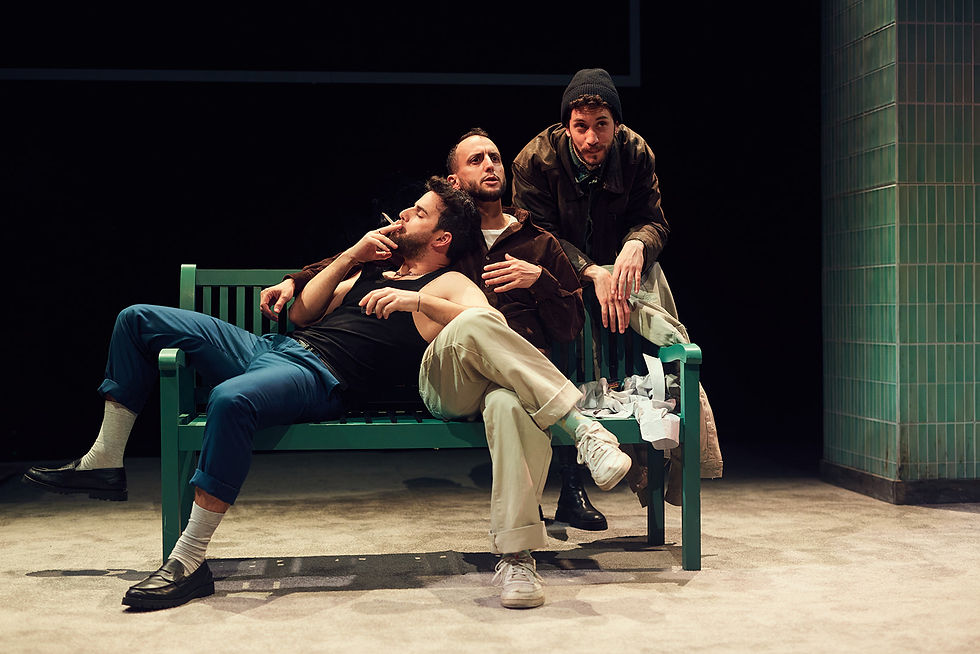
A friend of my mother's approached me after the premiere of "Geva Can't Fall in Love" (a full-length play directed by Rom Reznik that premiered in 2026 at The Triangle Theater, not to be confused, please, with "Geva Doesn't Know How to Fuck Properly," the short play that premiered in 2022 at Hameshulash Theater, the perceptive of you may notice a certain pattern), and said to me: "Listen, I was wary of coming at first because it's about gays, and wow, it was really tasteful. It didn't bother me at all." And I kind of chuckled to myself at that comment, but come on, isn't that what I'm actually trying to do? To make the gays in my plays so tasteful and straight passing that they're gay, but no one will feel like they're gay?
Ultimately, I believe that my plays should reflect how I see the world. If I live in a bubble where being gay is not a curse, but where actually beneath the surface there is internalized homophobia and a desire to be seen as a human being, then the world in my plays will also be a world where being gay is not a curse and beneath the surface there is internalized homophobia and a desire to be seen as a human being. I feel completely helpless in the face of the fact that Israel 2026 is infected with homophobia, and it is. Plays like "Priscilla Queen of the Desert" that celebrate gays on the biggest stage at Habima are perhaps a small step that can begin to make people who are homophobic see gays as non-issues. But I also want, and love, and believe in and adhere to writing and making theater that asks questions that I don't know how to answer. (Like this article, which asks a question that I don't know how to answer, I now realize) And it seems to me that such a theater, privileged and delusional and with internalized homophobia, is also important.


Comments