
The Gay Revolution Succeeded!
So why do we still need an independent LGBTQ+ theater?
A drag musical fills the National Theater, LGBTQ+ stories have entered the repertoire, and the audience is voting with their feet. So why do we still need our own theater? Nimrod Danishman, playwright and co-founder and director of Hameshulash (Triangle) Theater, on the difference between getting a place on stage and owning your own stage.

When we founded Hameshulash Theater – Tel Aviv’s LGBTQ+ theater, there were almost no LGBT plays in the Israeli theater landscape. It was in the summer of 2021, in a world that was reopening after the coronavirus pandemic. At the time, we were three independent creators who were traveling around with their independent plays, which happened to be LGBTQ+ centered, we looked left and right and didn’t see ourselves on stages in Israel. Not in plays translated and adapted from abroad, and certainly not in any original Israeli LGBTQ+ centered work.
Now you say: "Angels in America." And I will say: True, the Cameri Theater already produced "Angels in America" in the early 1990s, long before Gilad Kimchi's masterpiece, but 1. That was a long time ago and 2. That was really a drop in the ocean.
And now you say: Fringe! There were LGBT plays in the Fringe theater scene. And I'll say it again: True. Gary Bilu's Tahel Theater was a proud theater that brought to Israel works like "The Normal Heart," "In Seventh Heaven," and "The Story of a Pink Triangle." But it closed in 2017, leaving an empty space. In the years that followed, it is worth noting "Room 414" by the Playwrights Project, "Father of the Year" by Ido Colton, Noa Atia's female adaptation of "Scenes from a Marriage," as well as my own "Borders" . There were LGBT works, but there was no permanent home that was committed to the fact that after this work the next work would also come.
Fast forward five years, and it seems that almost every Israeli repertory theater stages at least one LGBTQ+ play per season (details of which can be seen in Amir Zloter's column). And if the National Theater's most successful play is a musical about drag, it's worth asking: Why do we need an independent LGBTQ+ theater?
Fortunately, the current artistic managements have understood that representing LGBTQ+ people in their repertoire is important. They realized that while LGBTQ+ stories have flooded television, cinema, and literature, Israeli theater has lagged behind for years. It should be mentioned that while it seems that most Israeli society accepts LGBT identities – even on Big Brother, where Aliyah Hoff was given a place of honor as a trans woman – the reality is still far from equal. We are a community that is distinct, but intersects with many different communities. There are gay people in Tel Aviv and in the country's periphery, in liberal families but also in conservative families. Theater, which is one of the most social and political art forms there is, must present LGBTQ+ stories on stage, because when we ignore LGBTQ+ people on stage, we ignore LGBTQ+ existence and leave it to be regarded as a curiosity at best, and as a marginalized community at worst.
There is, of course, also an economic aspect here: LGBTQ+ people in general consume art and buy plenty of tickets to the theater. I haven't researched it, but "some of my best friends" are known to, so to speak.
This is as of this moment.
But the LGBTQ+ community is currently under attack, like all minority communities that deviate from the political mainstream. No one can guarantee that the next director of the Cameri Theater will want to incorporate LGBTQ+ content into their repertoire. Forgive my morbidness, but 1920s Berlin was a paradise for queers, and a decade later, gays were marked with a pink triangle and sent to die in concentration camps. What seems obvious now may not necessarily remain so.
I'm not willing to allow my ability to see myself on stage to depend on what some artistic director thinks is important right now. In the proud theater, the LGBTQ+ story will always be at the forefront, and not just because it suits a specific subscription season.
Proud theater is not just a refuge for the community, and its role is not limited to keeping the embers burning in case the big theaters stop presenting us on stage one day. LGBTQ+ theater is first and foremost aimed at the LGBTQ+ community, and therefore it is free from the limitations of large commercial theaters that appeal to the general public. When I write for a broad audience, I actually have to mediate the LGBTQ+ experience. For example, in my play, "Borders," story of two gay men, Israeli and Lebanese, who speak through the dating app Grindr. The play opened with a slide explaining what this app is, how it works, and that because it is based on location distance, a guy from northern Israel and a guy from southern Lebanon could speak there.
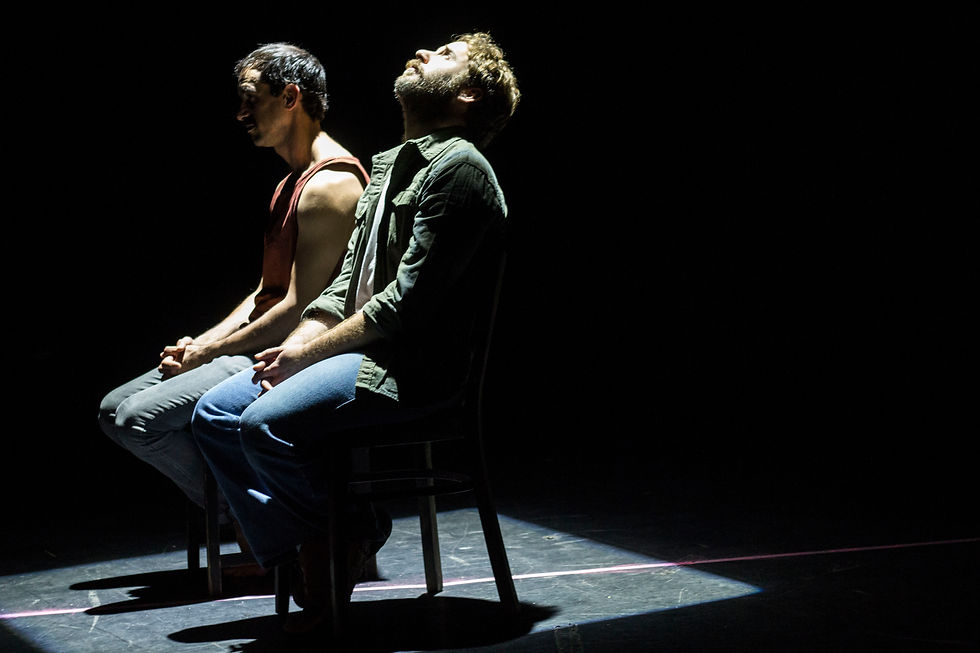
Three years after the show came out, in our cult musical "The One" (Rom Reznik and Cnaan Levkovich), in a number about Grindr, an anonymous character suddenly asks, "Have you ever had to wear a cast?", and this retort became a litmus test for knowing who in the gay audience uses the app and who doesn't, because every gay person who has been on Grindr has probably encountered an anonymous account at least once that asked them this question, and they laugh.
When we first address the LGBTQ+ community, within the LGBTQ+ center that is intended for this community, we do not have a mission to present only a positive representation of LGBTQ+ people on stage. In fact, we have the privilege of taking out the dirty laundry. We can also present our characters with their flaws: they can be ugly, horny, drug addicted, confused. We can present internalized homophobia, racism, misogyny, loneliness, sex and ageism. There is no fear that we will give the community a bad name, because the discussion is an internal discussion with the community. Many in Israel recoiled at the recent screening of the film NAZA at the Venice Film Festival, because we felt like it was unfair. How can anyone over there in Italy weigh in on this story that has nothing do to with them? It is our story, which I believe must be told, but there is significance in the question of where and to whom we tell it. The soul-searching that needs to be done is ours, not theirs. When we are free to present our characters as non-ambassadors, we write better plays, because the characters are human. We can present violent relationships and prostitution in “Fucking Man” (Joe DiPietro), internalized homophobia in “The One” (Rom Reznik and Cnaan Levkovich), and lesbian obsession in “Collective Rage” (Jen Silverman). We are not watching a caged animal, we are the animal itself.

And the beauty is that the moment the minority stops being the object of observation and becomes the observer, theater itself becomes a political act. When theater showcases the story of a person, any person, of any identity, on stage, it is as if telling them: "I see you, and you matter." But in LGBTQ+ theater, something else happens: we don't just ask the general audience to feel empathy for us, but we practice looking at ourselves. We can argue with ourselves, criticize ourselves, present on stage the disputes within us and still remain a community.
Oscar Eustis, the legendary director of New York's Public Theater (and the one who sent Tony Kushner to write a play about the impact of the AIDS epidemic on American society, and also gave the stage to Lin-Manuel Miranda's "Hamilton", but that's not related), once said that theater is important because democracy is important. According to him, theater trains the audience in empathy, but it also presents us with a conflict between two conflicting values, just like in parliament, where a coalition and an opposition hold opposing values and confront one another. In this sense, the dramatic conflict is an artistic representation of the democratic dispute. And perhaps most importantly, he says, watching theater is a communal act: an entire audience gathers in one room, watches this conflict together, and is required to contain both sides of it.
Therefore, LGBTQ+ theater, as a cultural institution of a minority community, is not secluded from democratic society but part of its infrastructure. It allows the community to not only be represented within the culture of the majority, but to create a culture of its own; not only to be gazed at, but to hold the gaze; not only to be included in the story, but to tell it.
So has the gay revolution been successful in theater? In some ways, yes, and it's amazing that the National Theater is managing to fill halls with a musical about drag. But the success of representation doesn't mean that LGBTQ+ theater is unnecessary. Perhaps even the opposite. The success of the LGBTQ+ story in institutional theater allows us to finally stop fighting for our right to be on stage, and start asking what we want to say once we're finally on it.

Comments